Genomic newborn screening
WGS from a dried blood spot, analysing 743 selected genes associated with serious inherited conditions. It complements biochemical newborn screening, with clinical interpretation and support for the family.
A visual journey from DNA and genome sequencing to expert interpretation.
Explore the journey from DNA to personalised care.
Laboratory accreditation
Quality in laboratory services
Information security certification
Data protection and confidentiality
Scientific Director: Ioannis L. Loukas, Professor, National and Kapodistrian University of Athens
150,000 genetic test reports signed during his professional career.
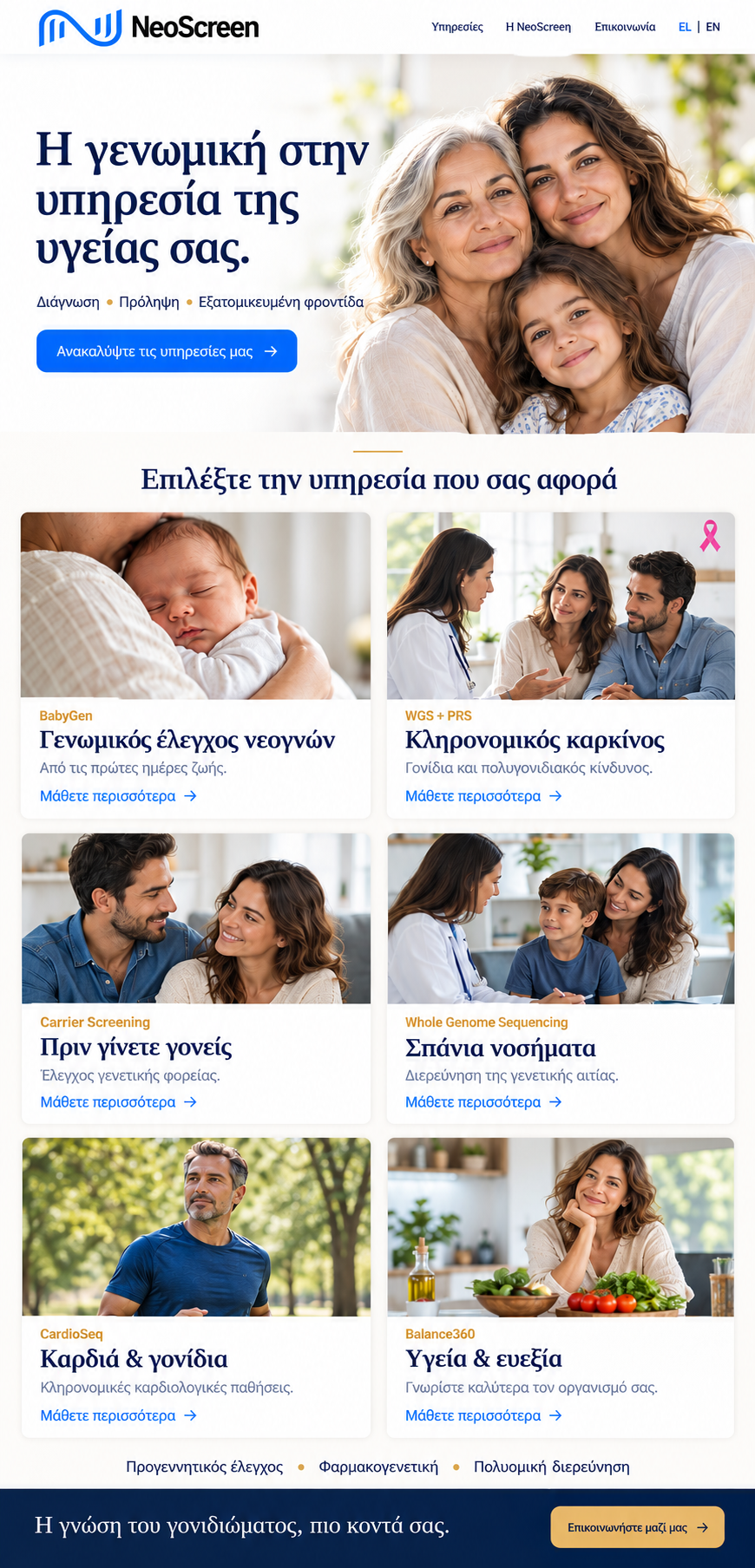
WGS from a dried blood spot, analysing 743 selected genes associated with serious inherited conditions. It complements biochemical newborn screening, with clinical interpretation and support for the family.
Targeted whole-gene analysis: from 26 breast cancer genes to 92 hereditary cancer genes. Clinical WGS and PRS for breast, ovarian and prostate cancer, with personalised interpretation guided by clinical history.
Carrier screening of 2,216 genes with WGS or WES. The WGS option includes molecular karyotyping and KIR. For couples and individuals planning a family, with combined interpretation of the results.
Investigation of complex or undiagnosed conditions in children and adults. Where appropriate, WGS is combined with RNA sequencing, metabolomics and long-read sequencing to investigate the underlying cause and interpret findings.
WGS analysing more than 500 cardiovascular genes associated with cardiomyopathies, arrhythmias, arterial disorders and familial hypercholesterolaemia. Clinical interpretation considers the patient’s history to guide assessment and follow-up.
Proactive comes first: genetic predisposition screening for monogenic conditions. It is followed by nutrigenetics, skin genetics, pharmacogenomics & HLA, PRS and genetic ancestry in your personal 100-page Genomic Book of Your Life.
Pharmacogenetic analysis through WGS gives your clinician genetic information to support the selection and dosing of specific medicines.
Whole-genome sequencing of the fetus and comparative parental analysis to investigate genetic conditions when there is a clinical indication.
Through the Rare-ID research project, NeoScreen introduced the first application of whole-genome sequencing (WGS) in Greece for the investigation of rare diseases.
WGS for rare diseases · A first in Greece
The Rare-ID project & its fundingESPA / NSRF 2014–2020 · Research – Create – Innovate
Co-funded by the European Regional Development Fund and Greek national resources through EPAnEK.
Scientific work involving NeoScreen and its team.
Our study of symptomatic neonates and young infants with complex clinical features.
Read the publicationRare-ID: Genomic Diagnosis in Symptomatic Neonates and Young Infants with Complex Clinical Phenotypes: A Descriptive Cohort Study.
Loukas YL et al. · Genes 2026;17(8):952.
DOI: 10.3390/genes17080952
NeoScreen’s contribution to a Greek study of developmental and epileptic encephalopathies.
Read the publicationMotor phenotyping in a Greek cohort of patients with neonatal and infantile onset developmental and epileptic encephalopathy.
Kollia E et al. · Eur J Paediatr Neurol. 2025;55:1–8.
DOI: 10.1016/j.ejpn.2025.03.001
A metabolomic profiling study in patients with breast cancer, using dried blood spot samples.
Read the publicationA simplified metabolomic analysis of dried blood spots in breast cancer patients.
Thodi G et al. · Scand J Clin Lab Invest. 2024;84(5):326–335.
DOI: 10.1080/00365513.2024.2392241
Investigation of undiagnosed paediatric neurological conditions. Abstract EPNS23-2954, page 530.
Read the abstract15th European Paediatric Neurology Society Congress, Prague, 20–24 June 2023. RARE-ID oral presentation by Ioannis L. Loukas.
NeoScreen combines genomics, bioinformatics and multiomics investigation, with clinical interpretation by a multidisciplinary team. We support healthcare professionals and families with clearly explained results and scientific guidance.