Balance360
Proactive screening, prevention and personal genetic knowledge.
Balance360 begins with Proactive monogenic screening to identify genetic predisposition to inherited disorders. It continues with five complementary sections covering nutrition, skin, pharmacogenomics and HLA, PRS and genetic ancestry, in a personal 100-page Genomic Book of Your Life.

01 · Proactive — Monogenic screening
Proactive screening looks for genetic variants in 181 genes of high clinical significance associated with serious inherited disorders. Its aim is to identify genetic risk early and support preventive medical monitoring.
Pathogenic or likely pathogenic findings are interpreted alongside personal and family history. A predisposition finding does not mean that disease will certainly develop, while the absence of a finding does not exclude every genetic risk. The clinician determines the appropriate next steps.
Sources & evidence ↓Proactive comes first. Six sections of personal knowledge.
of Your Life100 pages of personal knowledge
Schematic presentation of the report
The presentation begins with preventive screening for monogenic disorders and continues with five sections on wellness and personal genetic information.
A personal book that gives information meaning
The Genomic Book of Your Life organises genetic knowledge around prevention and everyday care. Balance360 combines six sections: Proactive monogenic screening, nutrigenetics, skin genetics, pharmacogenomics and HLA, polygenic predisposition and genetic ancestry.
Each section provides a different type of information. The overall picture becomes valuable when connected with your history, habits, investigations and personal goals. This can make discussions with your clinician, dietitian or other appropriate healthcare professional more specific.
Six sections, beginning with Proactive screening
02 · Nutrigenetics
The nutrigenetics section explores genetic associations relevant to nutrition. It helps explain why people with different genetic backgrounds may have different predispositions, and why personalisation requires more than general dietary advice.

The findings provide complementary information for a dietitian's assessment. Actual nutritional needs are also shaped by age, health, activity, eating habits and laboratory measurements. Genetic predisposition is not the same as a measured nutritional deficiency or a need for a particular supplement.
Genetic information relevant to nutrition.
Discussion of findings alongside dietary and medical history.
Support for a personalised approach with appropriate professional guidance.
03 · Skin genetics
The skin genetics section presents genetic information relevant to skin characteristics and predispositions. It offers an additional perspective on personal care that can be discussed with a dermatologist.

Genetic background is only one part of the picture. Age, environment, sun exposure, habits and the actual condition of the skin remain essential elements of assessment. Care choices are based on this combined picture and the individual's needs.
Sources & evidence ↓04 · Pharmacogenomics & HLA
Pharmacogenomics examines how genetic differences may affect metabolism, response or the risk of adverse effects for certain medicines. The HLA section adds information from immune-system genes, interpreted according to the finding and its application.

These results are useful in discussions with the treating clinician. Choice of medicine and dose takes account of the diagnosis, other medicines and overall health. Treatment is changed only in consultation with the clinician responsible for it.
Sources & evidence ↓05 · Polygenic predisposition — PRS
Polygenic risk scores summarise the cumulative effect of many genetic variants. A result's position within the distribution of a reference population helps describe relative genetic predisposition.
To turn this information into a useful assessment, it needs to be connected with age, family history, lifestyle and other clinical factors. A higher PRS is not a diagnosis, and a lower PRS does not guarantee that a disease will not occur. Model selection and calibration are relevant to interpretation.
Sources & evidence ↓06 · Genetic ancestry
Genetic ancestry analysis compares genetic patterns with reference populations and provides estimates of ancestral origins. It offers a different way to explore your personal history, complementing what you know about your family.
Estimates depend on the available databases and methodology. They may change as reference populations are expanded. They describe genetic similarities and do not determine nationality, cultural identity or a personal sense of ancestry.
Ancestry is estimated by comparison with reference data
Who may benefit?
Balance360 is designed for adults who want to understand their genetic background better. Proactive screening opens a discussion about inherited predisposition and preventive monitoring, while the other sections add information about wellness and everyday care.
When there are symptoms or a suspected specific familial condition, the NeoScreen team and treating clinician select the appropriate clinical investigation based on personal and family history.
Sources & evidence ↓Simple sample collection with a buccal swab
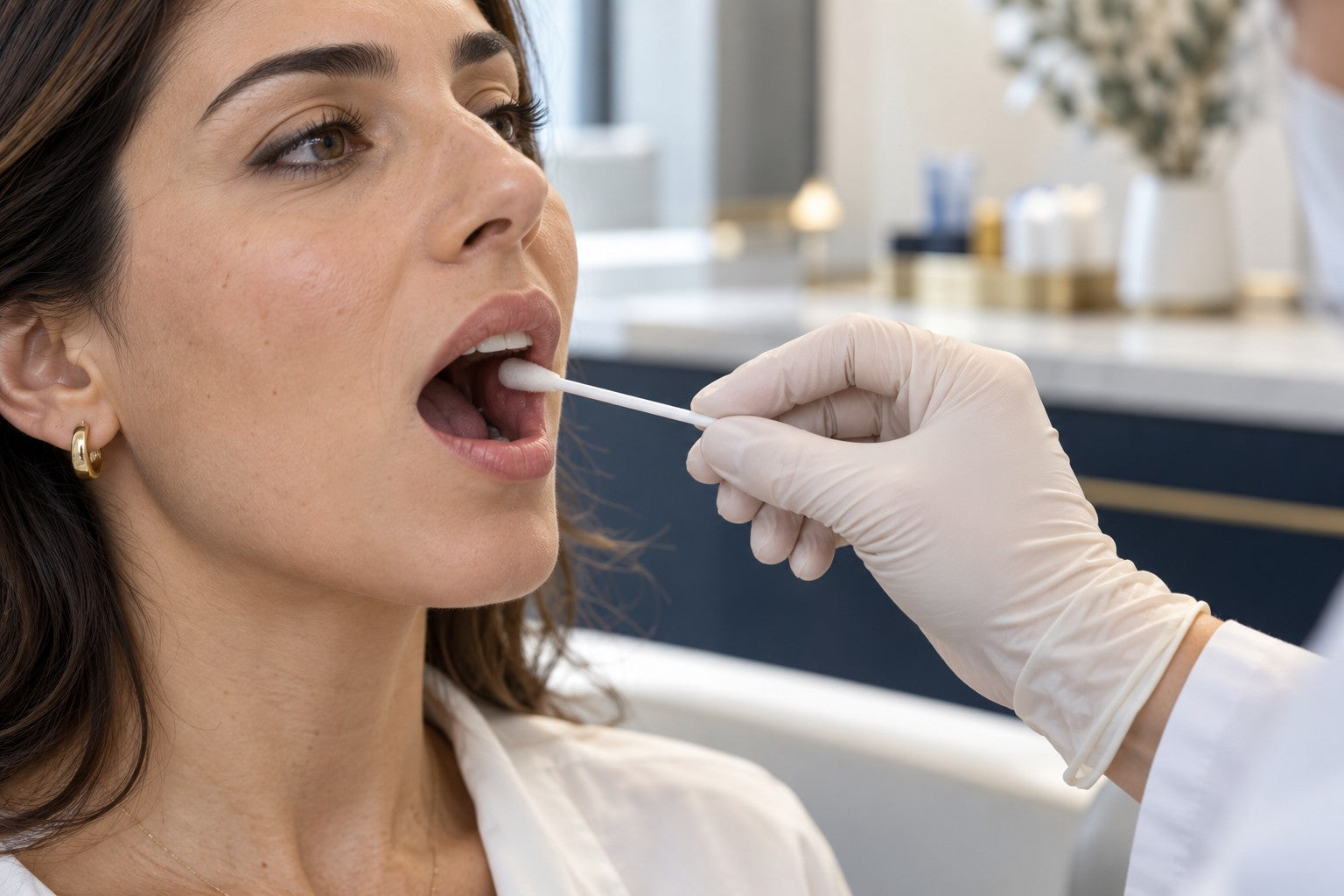
The Balance360 instructions specify collecting cells from the inner surface of the cheeks with a dedicated swab. Careful collection supports sample quality and laboratory analysis. Always follow the specific instructions provided with the kit and by the laboratory.
Preparation
for 30 minutes before collection, avoid food, drinks other than water, chewing gum, smoking and vaping.
Collection
using gentle, steady contact, make 10 slow circular movements on the right cheek and 10 on the left, according to the instruction leaflet.
Completion
immediately secure the swab in its case or tube, label it and return it according to the kit instructions.
From data to prevention and everyday care
The Balance360 result is an organised 100-page report, beginning with Proactive screening and followed by five complementary sections of genetic knowledge. Its structure helps you return to the information, note specific questions and discuss them with the appropriate healthcare professionals.

Reading the report begins with understanding exactly what each finding describes, how strong the association is and how it relates to your other information. Practical use follows from this discussion, with realistic priorities and choices tailored to your personal needs.
Sources & evidence ↓Frequently asked questions
What do the 100 pages include?
The report begins with Proactive monogenic screening. It continues with nutrigenetics, skin genetics, pharmacogenomics and HLA, polygenic predisposition (PRS) and genetic ancestry: six sections of personal genetic knowledge.
What does Proactive screening add?
It looks for genetic variants associated with serious inherited disorders. Clinical interpretation may help the clinician organise targeted monitoring. A predisposition finding cannot predict with certainty whether or when a disease will occur.
Will I receive a specific diet or a prescription?
The report provides genetic information and interpretation. A personalised dietary plan and treatment decisions require assessment by the appropriate healthcare professional.
Do I need any special preparation?
For buccal swab collection, follow the instructions provided with the kit. The Balance360 leaflet includes brief preparation before collection and specific instructions for collection and return.
Can I use it to investigate a symptom?
Discuss the symptom and history with the NeoScreen team and your clinician so that the appropriate clinical test can be selected. Proactive screening has a preventive focus; a predisposition finding is interpreted in the context of the clinical picture.
Does genetic ancestry provide definitive percentages of origin?
The estimates are based on comparison with reference populations. Accuracy and resolution depend on the method and available data, so the results should be read as statistical estimates.
Sources & scientific evidence
Service description: NeoScreen information brochure, October 2026 edition, p. 10. The Proactive section is based on the “Proactive Health Genes” description in NeoScreen's information material, covering 181 genes of high clinical significance. Sample collection: Balance360 buccal swab instructions.
Knowledge becomes care.NeoScreen · 5,000+ WGS / WES analyses
Scientific Director: Ioannis L. Loukas, Professor, National and Kapodistrian University of Athens
Start with prevention. Understand your genetic background.
Talk to NeoScreen about Proactive screening and the six sections of Balance360.
