Rare diseases & Multiomics
From genetic variation to function. From information to a clinical answer.
For complex or undiagnosed cases, identifying the cause requires us to connect the clinical picture with different layers of biological information. NeoScreen uses WGS as a broad foundation for investigation and, where indicated, adds RNA sequencing, metabolomics or long-read sequencing to explore the disease mechanism in greater depth.

Explore each layer of investigation
Select a procedure to discover what it examines, how it works and when it can add useful information.

DNA / WGS
Which genetic change are we looking for?
Explore the procedure ↓
RNA sequencing
How is function affected?
Explore the procedure ↓
Metabolomics
What is the biochemical signature?
Explore the procedure ↓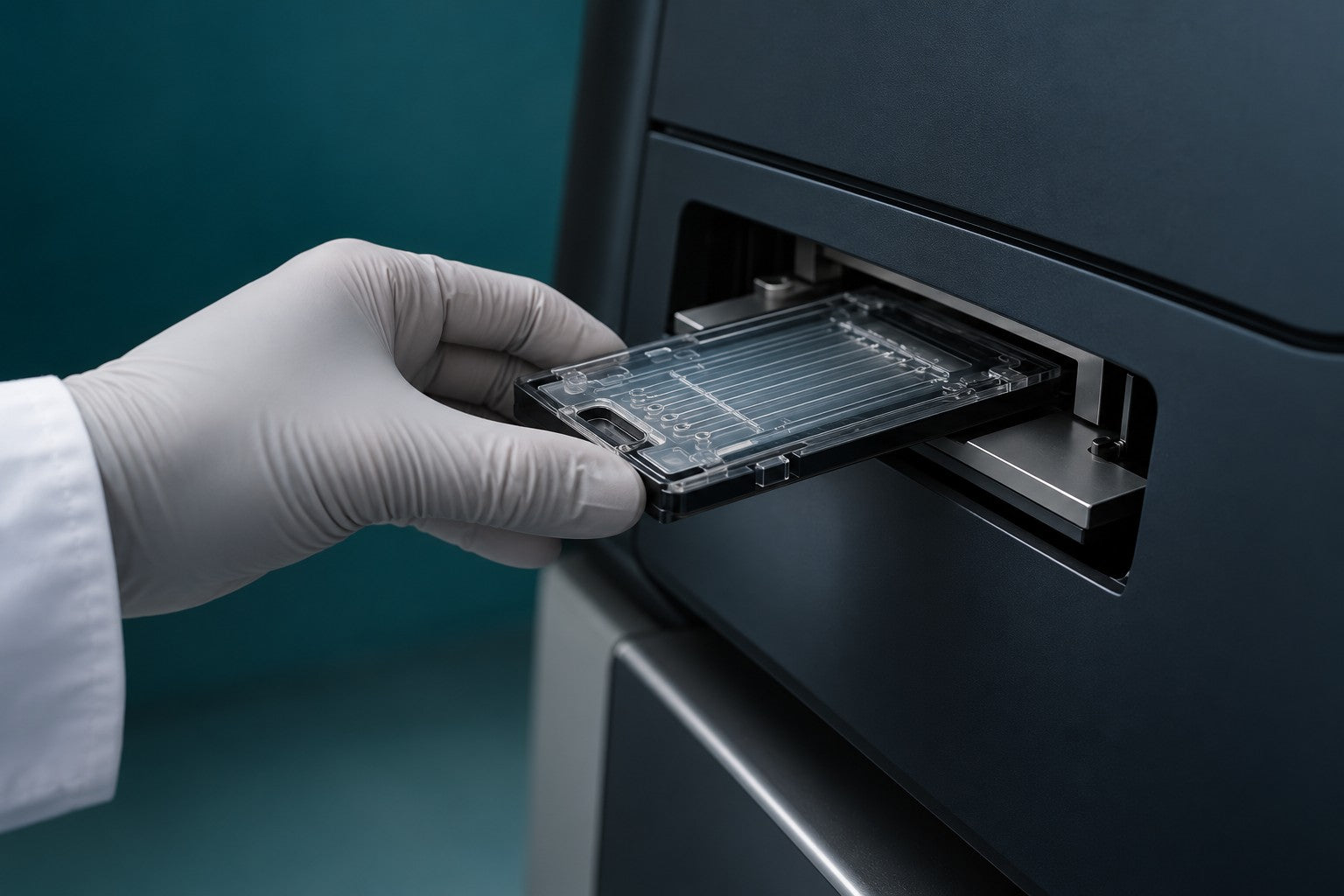
Long-read sequencing
How do we investigate complex regions?
Explore the procedure ↓The images illustrate the procedures. Additional tests are selected for each case and are not automatically included in every WGS analysis.
When the diagnosis remains unresolved
This service supports the investigation of children and adults with a suspected genetic disorder, particularly when the clinical picture is complex or previous tests have not provided an adequate answer. The treating clinician's specific question is always the starting point.

Personal and family history, age at onset, laboratory tests, imaging findings and previous genetic results help guide the choice and interpretation of the analysis. A fuller description of the patient's clinical picture can be just as important as the technology itself.
Neurodevelopmental or complex neurological manifestations.
Epileptic encephalopathies and symptomatic newborns or infants.
Hypotonia, neuromuscular involvement and myopathies.
Congenital anomalies and multisystem manifestations.
Suspected metabolic or neurometabolic disorders.
Cases with a previous non-diagnostic gene panel or WES result.
WGS: a broader field of investigation
Whole Genome Sequencing generates data across the entire genome. Clinical analysis focuses on variants that may be relevant to the patient's presentation and is performed within the validated scope of the laboratory and bioinformatics workflow.
The approach may include small sequence changes, deletions or duplications and other types of genetic variation. Which findings can be detected and reported depends on coverage, variant type, appropriate software and the reporting policy.
SNVs and small indels
changes in the genetic sequence.
CNVs and structural variants
losses, additional copies or rearrangements of genetic material.
Selected intronic and non-coding regions of clinical interest.
Mitochondrial and complex findings, where covered by the validated analysis.
The possibility of reanalysis as the phenotype and scientific knowledge evolve.
Genetic information beyond the exons
Three layers of information, one clinical question
Multiomics investigation connects a genetic change with its effects. Different tests are selected because they address complementary questions. Converging findings may strengthen interpretation; divergent findings can guide the next step.
DNA / WGS
Which variant could explain the clinical picture?
RNA
Are the splicing, abundance or expression of the relevant transcript affected?
Metabolomics
Is there a biochemical pattern consistent with the proposed mechanism?
RNA sequencing: when functional evidence is needed
A candidate DNA variant may require further evidence to establish an association with disease. RNA analysis examines the functional expression of genetic information and can investigate abnormalities in splicing or gene expression.
For example, the test may reveal unusual exon joining or reduced expression of a gene under investigation. Tissue suitability and expression of the particular gene in the sample affect whether a question can be answered. Sample selection therefore comes before testing.
Investigating a possible effect on splicing.
Assessing gene expression.
Additional evidence for interpreting selected variants.
How RNA reveals splicing
Metabolomics: the biochemical side of the investigation
Metabolomics examines small molecules and patterns that reflect the activity of metabolic pathways. Within the Multiomic Profile, it can support the investigation of metabolic and neurometabolic disorders and help connect genetic findings with biochemical consequences.
A targeted approach focuses on specific metabolites or pathways. An untargeted approach examines broader patterns. The choice is based on the clinical suspicion and tests already available, so that the additional information addresses a clear diagnostic question.
From sample to metabolic pattern
Selecting suitable biological material.
Processing according to the protocol.
Laboratory measurement of metabolites.
Connecting findings with the clinical question.
Long-read sequencing: exploring the most challenging regions
Long-read sequencing may be used when the clinical question concerns complex structural changes, repeat expansions or genomic regions that are difficult to resolve with shorter reads.
It can also help investigate phasing: whether two variants are located on the same or different copies of a gene. This information may be crucial to understanding inheritance. Long-read sequencing is a focused choice within the diagnostic pathway, depending on the indication and available validated applications.
When a long read spans a challenging region
After non-diagnostic WES or WGS
A previous non-diagnostic result does not always end the investigation. The clinical picture may need reassessment, the scope may need widening, existing data may need reanalysis, or a test may be needed to examine a variant's functional consequences.
NeoScreen's presentation on diagnostic findings after negative WES describes different categories of findings: coding variants, intronic or splicing-related variants, copy-number changes and mitochondrial findings. This experience highlights the importance of individual reassessment without promising a particular success rate for every patient.
Sources & evidence ↓The patient pathway at NeoScreen
Planning begins with the collection of medical information. The initial analysis and any subsequent stages are discussed in relation to the clinical question, the availability of a suitable sample and the value of each test.
1. Referral and detailed documentation of the clinical picture, family history and previous results.
2. Selection of the scope of analysis, informed consent and guidance on the appropriate sample.
3. Laboratory quality control and sequencing.
4. Bioinformatics processing and clinical curation of findings.
5. Confirmation or targeted family testing, where needed.
6. Selection of RNA analysis, metabolomics or long reads when they can add useful information.
7. Reporting and discussion of the conclusions with the treating clinician.
What the final result means
The report relates the findings to the indication for testing and explains what the available evidence supports. Some cases may receive a molecular diagnosis. In others, candidate findings require additional evidence, or the analysis remains non-diagnostic.
Variants of uncertain significance require particular care in interpretation. The next step may involve testing relatives, a functional test or reanalysis when new clinical information becomes available. Additional tests are determined individually and are not automatically included in every WGS analysis.
Sources & evidence ↓Rare-ID: ESPA, approximately €1 million and pioneering WGS
Rare-ID is a research project involving NeoScreen, with a total budget of €997,360, supported by ESPA / NSRF and the “Research – Create – Innovate” programme. Within the project, NeoScreen applied whole-genome sequencing (WGS) for the first time in Greece to investigate rare diseases, combining genomics with metabolomics.
WGS for rare diseases · A first in Greece
The research focused on rare neurological and neurodevelopmental disorders in children and neonates, in collaboration with the University of Athens and clinical partners.
ESPA / NSRF 2014–2020 · Research – Create – Innovate
The Rare-ID publication in Genes presents a Greek multicentre experience involving 25 symptomatic newborns and young infants with complex clinical presentations and no established molecular diagnosis at referral. The study highlights the value of genomic investigation and of connecting different types of findings with the clinical picture.
This is a descriptive study of selected symptomatic patients. Its conclusions relate to that clinical setting and do not measure the performance of screening in all newborns.
ESPA, project budget & collaborations
The collaborative project’s total approved budget was €997,360, comprising €857,984 in public funding and €139,376 in private contributions, according to the funding decision. The project was co-financed by the European Regional Development Fund and Greek national resources under the Research – Create – Innovate programme.
The funding decision lists the University of Athens Special Account for Research Funds, NEOGENETICS and Habilis as beneficiaries. Clinical collaboration included Attikon University Hospital and Professor of Pediatric Neurology Argirios Dinopoulos.
Project code: T1EDK-03332 · MIS 5048479
Frequently asked questions
Do all multiomics tests need to be performed together?
No. The Multiomic Profile is tailored to each case. RNA analysis, metabolomics and long-read sequencing are selected when they can answer a specific question and are agreed as separate stages.
If WES or WGS has already been performed, is another assessment worthwhile?
The team assesses what has already been analysed, the quality of the data and the current clinical question. Reanalysis, a different scope or a complementary method may be appropriate. The same next step is not needed for every patient.
Is a splicing prediction enough to establish the cause?
Computational prediction helps select findings for further investigation. Final classification considers all the evidence and, where appropriate and feasible, functional information from RNA analysis or another study.
Is a sample from parents or other relatives also needed?
Family testing may be requested to clarify inheritance or the relationship between a finding and the clinical picture. Its need and scope are determined during planning or after the initial analysis.
What sample is appropriate?
This depends on the test. Requirements for DNA, RNA and metabolomics differ. For RNA, the tissue in which the gene under investigation is expressed is relevant. Contact NeoScreen before collecting any sample.
Does a molecular diagnosis always lead to treatment?
Diagnostic information can support monitoring, genetic counselling and, for some disorders, treatment selection. Its practical use depends on the specific disorder and is determined by the treating team.
Sources & scientific evidence
Service description: NeoScreen information brochure, October 2026 edition, p. 5. Additional material: NeoScreen scientific presentation on WGS, Rare-ID, RNA and Multiomics.
- Loukas et al. · Rare-ID: Genomic Diagnosis in Symptomatic Neonates and Young Infants · Genes, 2026 ↗
- Kremer et al. · Genetic diagnosis of Mendelian disorders via RNA sequencing · Nature Communications, 2017 ↗
- Yépez et al. · Clinical implementation of RNA sequencing for Mendelian disease diagnostics · Genome Medicine, 2022 ↗
- ClinGen SVI · Interpreting RNA splicing evidence ↗
Knowledge becomes care.NeoScreen · 5,000+ WGS / WES analyses
Scientific Director: Ioannis L. Loukas, Professor, National and Kapodistrian University of Athens
Let us plan the next diagnostic step.
Gather the clinical summary and previous test results, and contact the NeoScreen team.
